Qounselor provides Master’s-level academic training dedicated to discovering the applications of quantum computers and critically analyzing their performance.
Example of training delivered at ESILV
Teaching objectives
The objective of this course is to introduce different quantum solution methods for combinatorial optimization problems:
Analog approaches
Variational algorithms
Unstructured search
The course emphasizes comparing results obtained with quantum machines and classical methods to critically analyze the performance and limitations of current quantum algorithms and hardware platforms.
Teaching content
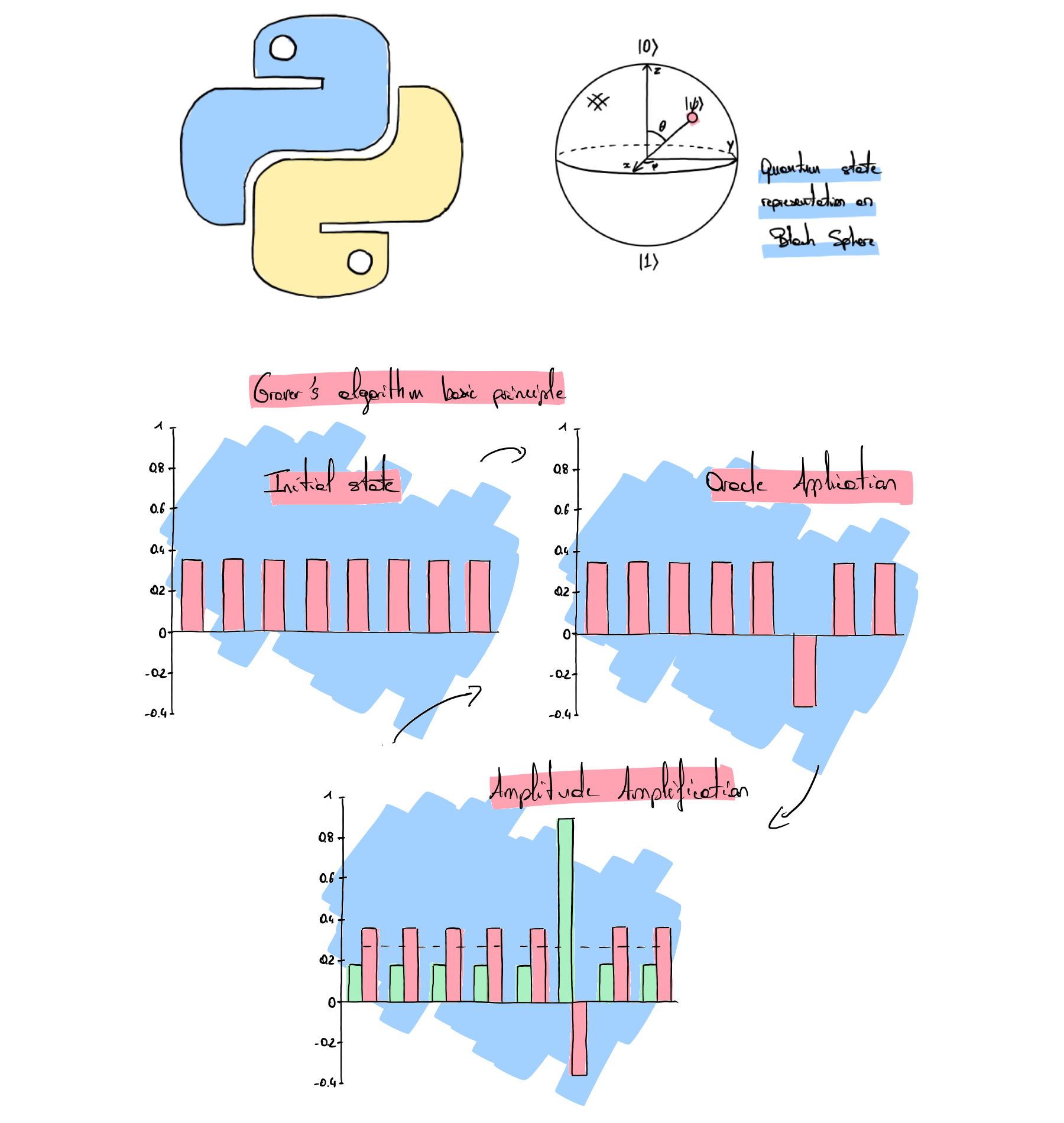
The program covers the formulation of QUBO (unconstrained quadratic binary optimization) problems, as well as selected methods from classical combinatorics, including heuristics such as simulated annealing and Tabu search, and deterministic methods such as branch and bound. Quantum combinatorial methods are then introduced, including adiabatic computing, quantum annealing, variational algorithms such as QAOA, and Grover’s algorithm.
The sessions combine theoretical content, exercises, and practical computer-based implementations, with experiments on emulators, simulators, and real quantum hardware.
Practical approach
The course is project-oriented. Students progressively build a library of classical and quantum algorithms for solving combinatorial optimization problems. This approach revisits theoretical concepts through practice and identifies the limitations of current quantum computers, such as noise and compilation costs.
Skills developed
By the end of the course, students are able to formulate an optimization problem as a QUBO, implement several classical and quantum methods to solve this problem, and critically analyze their performance. The course, therefore, aims to train profiles capable of concretely assessing the relevance of quantum technologies for applied use cases.
Let's get in touch !
Get in touch so we can learn more about your project and how we can help.
Privacy Policy
We receive, collect, and store any information you enter. We collect the information entered in the contact form: name, email address, phone number if provided, and the message content. This content is retrieved in a Google Form and stored on a free drive hosted by Google.
We collect this personal and non-personal information for the following purposes:
To provide a response to any user wishing to contact us.
This website is hosted on OVH Cloud platform. The data from the forms is stored on a free drive hosted by Google. Your data may be stored through data storage, databases, and general applications of ovhcloud.com and google.com. They store your data on secure servers behind a firewall.
If you no longer wish us to process your data, please contact us by email at valentin.gilbert@qounselor.fr. Your data submitted through the application form will then be deleted.
We reserve the right to modify this privacy policy at any time, so we encourage you to review it frequently. Changes and clarifications will take effect immediately upon publication on the website. If we make significant changes to this policy, we will notify you here of its update, so that you are aware of what information we collect, how we use it, and under what circumstances, if any, we use and/or disclose it.